

As science searches for answers on depression, what should patients do today?
Older Adults and Depression
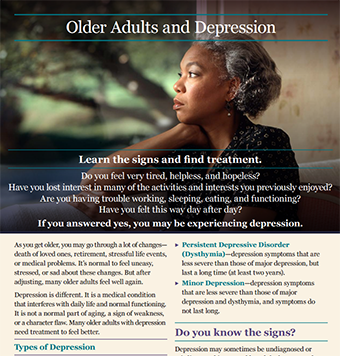
- Download PDF
- Download ePub
- Order a gratuitous hardcopy
- En español
Learn the signs and find treatment.
Do you feel very tired, helpless, and hopeless?
Have you lost interest in many of the activities and interests you previously enjoyed?
Are you having trouble working, sleeping, eating, and functioning?
Take you felt this way mean solar day later on day?
If you answered yeah, you may exist experiencing depression.
Every bit yous get older, you may get through a lot of changes—decease of loved ones, retirement, stressful life events, or medical issues. It's normal to feel uneasy, stressed, or distressing about these changes. Merely after adjusting, many older adults experience well again.
Depression is different. Information technology is a medical condition that interferes with daily life and normal functioning. It is not a normal part of crumbling, a sign of weakness, or a character flaw. Many older adults with depression need treatment to feel better.
Types of Low
In that location are several types of depression. The nigh common include:
- Major Depression—severe symptoms that interfere with your ability to work, sleep, concentrate, consume, and enjoy life. Some people may experience just a single episode within their lifetime, but more than often, a person may experience multiple episodes.
- Persistent Depressive Disorder (Dysthymia)—depression symptoms that are less severe than those of major depression, but last a long time (at least two years).
- Small-scale Depression—low symptoms that are less severe than those of major depression and dysthymia, and symptoms do not last long.
Do you know the signs?
Depression may sometimes be undiagnosed or misdiagnosed in some older adults because sadness is not their main symptom. They may have other, less obvious symptoms of depression or they may not exist willing to talk about their feelings. It is of import to know the signs and seek assistance if you are concerned.
Depression has many symptoms, including physical ones. If you take been experiencing several of the following symptoms for at least two weeks, yous may be suffering from depression:
- Persistent sad, broken-hearted, or "empty" mood
- Loss of interest or pleasure in hobbies and activities
- Feelings of hopelessness, pessimism
- Feelings of guilt, worthlessness, helplessness
- Decreased free energy, fatigue, being "slowed down"
- Difficulty concentrating, remembering, making decisions
- Difficulty sleeping, early on-forenoon enkindling, or oversleeping
- Appetite and/or unintended weight changes
- Thoughts of decease or suicide, suicide attempts
- Restlessness, irritability
- Aches or pains, headaches, cramps, or digestive bug without a clear concrete cause and/or that practise not ease even with handling
Is it Grief or Depression?
Grief after loss of a loved one is a normal reaction to loss and generally does non require mental wellness treatment. Withal, grief that lasts a very long time or is unusually astringent post-obit a loss may require handling.
Adventure Factors
Although about cases of depression are diagnosed in young adults, depression can occur at whatsoever historic period. Certain people are at a higher risk for developing depression. If you are an older adult, you lot may exist at a higher adventure if you:
- are female person
- have a chronic medical illness, such equally cancer, diabetes or heart disease
- have a disability
- slumber poorly
- are lonely or socially isolated
Y'all may besides be at a college adventure if yous:
- have a personal or family history of low
- use sure medications
- endure from a brain disease
- misuse alcohol or drugs
- have experienced stressful life events such as loss of a spouse, divorce, or taking care of someone with a chronic disease
How practice I get help?
If you call up that you or a loved 1 may have depression, it is important to seek treatment. A person with depression cannot simply "snap out of it"—it is a medical condition that affects your quality of life. Depression can also atomic number 82 to suicide, especially if left untreated, and you are more likely to develop a physical illness if you have depression.
The good news is that, in most cases, depression is treatable in older adults. The right treatment may assist improve your overall health and quality of life. With the correct treatment, y'all may begin to see improvements as early as 2 weeks from the start of your therapy. Some symptoms may start to improve within a week or two, merely it may be several weeks before you feel the full effect.
Talking to Your Md
If you lot retrieve y'all have depression, the first step is to talk to your doctor or health care provider. Your doctor volition review your medical history and practise a physical exam to rule out other conditions that may be causing or contributing to your depression symptoms. He or she may too ask you a series of questions about how you're feeling. It is of import to exist open and honest about your symptoms, even if you feel embarrassed or shy.
If other factors tin can be ruled out, the doctor may refer you to a mental wellness professional person, such as a psychologist, counselor, social worker, or psychiatrist. Some providers are specially trained to treat low and other emotional problems in older adults.
What are my treatment options?
The main treatment options for depression include medication and psychotherapy. It is of import to call up that as doctors and therapists develop a personalized handling programme for each individual, different treatments or treatment combinations sometimes might be tried until you find ane that works for you.
Medication
Medications called antidepressants can work well to treat depression. While some symptoms normally begin to improve inside a week or two, they can accept several weeks to piece of work fully. As with well-nigh medications, many people experience some side effects, which in most cases tin can be managed or minimized. The most mutual side effects of antidepressants include:
- Nausea and vomiting
- Weight gain
- Diarrhea
- Sleepiness
- Sexual issues
Antidepressants may cause other side effects that are not included in this list. Well-nigh side furnishings lessen over time. If y'all are taking antidepressants, talk to your doctor nearly whatever side furnishings that you are experiencing, specially if they are new, worsen over time, or worry y'all. Often, temporarily lowering the dose or switching to a different medication volition aid when side effects are problematic. If you have thoughts of suicide or experience whatever unusual changes in mood and behavior, call your doctor right abroad.
People over 65 have to be careful when taking medications, specially when they're taking medications for unlike conditions. Older adults accept a higher risk for experiencing bad drug interactions, missing doses, or overdosing. Exist sure to tell every doc you see about all of the medications you are being prescribed. It is as well a skillful thought to get all of your medications from the aforementioned chemist's; pharmacists are first-class sources of information about medications and will alert yous and your doctors if at that place are concerns virtually a possible interaction betwixt medications—which can happen inadvertently when a doctor is non familiar with a medication being prescribed for a dissimilar condition by a different health care provider.
Older adults likewise tend to be more than sensitive to medications. Therefore, lower or less frequent doses may be needed. Before starting a medication, older adults and their family members should talk with a doctor nearly whether a medication can affect alacrity, retentiveness, or coordination, and how to help ensure that prescribed medications exercise not increase the adventure of falls. If yous have trouble remembering to take multiple doses of medicines throughout the mean solar day, your doctor may want to prescribe one of the antidepressants that require simply ane dose daily; either way, antidepressants must exist taken every single day, non simply "as needed."
If you are taking antidepressants, it is of import to not stop taking them without the assist of a medico.
Even afterward you are feeling back to yourself, antidepressants should be continued for a number of months to forestall depression symptoms from returning. When it is time to cease the medication, the doctor volition assist y'all slowly and safely decrease the dose. It's important to give the trunk fourth dimension to conform to the change. People don't get addicted to (or "hooked on") these medications, but stopping them abruptly may cause withdrawal symptoms.
Psychotherapy
Psychotherapy (or "talk therapy") can also exist an constructive treatment for depression. Information technology helps by teaching new ways of thinking and behaving, and changing habits that may contribute to the depression. Psychotherapy can assist yous understand and work through difficult relationships or situations that may exist causing your depression or making information technology worse. Research shows that cognitive-behavioral therapy (CBT), including a version chosen problem-solving therapy, may be an specially useful blazon of psychotherapy for treating older adults and improving their quality of life.
Research also suggests that for older adults, psychotherapy is just every bit likely to be an constructive first treatment for low as taking an antidepressant. Some older adults prefer to get counseling or psychotherapy for depression rather than add more medications to those they are already taking for other conditions. However, if your depression is astringent or if you are coping with other serious illnesses, medication or a combination of medications with psychotherapy may be a more than effective approach.
Complementary Therapies
Examples of complementary therapies for depression include yoga, practise, and sure dietary supplements. These therapies may offering some benefits for people with depression; however, they should not supercede talking to your health care professional person or continuing with the treatment plan adamant with that doctor. Tell your wellness care professional about whatever complementary health approaches you use or plan to utilise. This will help ensure your safe. Concrete activity is a helpful role of any treatment plan for low, and may become easier to add as a person starts to feel better as antidepressant medication and/or psychotherapy begin to work. Talk to your health care professional person virtually your options and visit the National Center for Complementary and Integrative Health to learn more about these types of therapies: www.nccih.nih.gov.
Electroconvulsive Therapy (ECT)
Electroconvulsive therapy (ECT) is sometimes used for severe depression that is very difficult to treat and does non respond to medication or psychotherapy. ECT is a blazon of brain stimulation therapy, a class of treatments which involve activating the brain direct with electricity, magnets, or implants. Some of these treatments are still at the experimental stage. If your low persists despite adequate trials of medication, or if your low is so astringent that you are unable to eat or you develop false, fixed behavior ("delusions") about your illness, your doctor may recommend ECT as the all-time selection. Although it has been in use for nearly fourscore years, ECT remains the strongest and fastest-acting treatment for astringent depression.
Despite ECT'due south efficacy and safety tape in older adults, many misconceptions even so persist amidst both patients and wellness care professionals. ECT can be condom and highly effective for astringent, treatment-resistant depression, as well equally a variety of other serious mental disorders. ECT may cause side effects, such as confusion and memory loss. Although these side effects are usually brusque-term, they can sometimes linger.
Across Handling: What You Can Do
As you continue treatment, you may gradually start to feel amend. Call up that if yous are taking medication, it may have several weeks for it to start working. If the first medication does not work, be open to trying another. You may demand to try a few different medications before finding one that works for you. Sometimes, if an antidepressant medication is simply partially effective, adding a 2nd medication of a different blazon can be helpful.
Try to do things that you used to savour before you had depression. Studies have shown that doing these things, even when you don't wait to relish them, can help elevator your spirits. Go easy on yourself. Other things that may aid:
- Break upward large tasks into minor ones, and exercise what you can equally you tin can. Don't try to practice likewise many things at in one case.
- Spend time with other people and talk to a friend or relative about your feelings.
- Stick to your treatment plan. It will accept time for handling to work.
- Discuss decisions with others who know y'all well. Practise not brand important life decisions until you lot experience better.
If you are having suicidal thoughts
Older adults with depression are at risk for suicide. If you are thinking most harming yourself or attempting suicide, tell someone who can help immediately.
- Call your doctor.
- Call 911 for emergency services.
- Get to the nearest hospital emergency room.
- Call the price-free, 24-60 minutes hotline of the National Suicide Prevention Lifeline at i-800-273-TALK (ane-800-273-8255) to be connected to a trained counselor at a suicide crisis center nearest you.
How do I help someone with low?
If you lot know someone who has depression, first aid him or her see a dr. or mental health professional person. Several ways you tin can aid an older developed with depression is to:
- Offer support, understanding, patience, and encouragement.
- Help proceed track of his or her appointments and weekly "pillbox" if possible considering many older adults with depression may not exist thinking clearly.
- Endeavour to brand sure he or she has a way of getting to dr. visits.
- Talk to him or her, and listen carefully.
- Never ignore comments most suicide, and study them to your loved i's therapist or md.
- Invite him or her out for walks or outings, or to appoint in indoor activities with you.
- Remind him or her that, with time and handling, the low volition lift.
Where can I find more data?
NIMH has a variety of publications on depression available at www.nimh.nih.gov/wellness/publications/. If you demand additional data and support, you lot may discover the following resources to be helpful:
Clinical Trials and You Clinical trials are part of clinical enquiry and at the heart of all medical advances. Clinical trials look at new means to prevent, discover, or treat disease. Treatments might be new drugs or new combinations of drugs, new surgical procedures or devices, or new means to use existing treatments. All clinical trials take particular requirements to friction match potential subjects with studies, such as historic period range or acceptable other conditions/medications. To learn more near participating in a clinical trial, please visit www.nih.gov/health/clinicaltrials/index.htm and employ search terms such as "geriatric depression" or "depression and older adults."
Locate Affordable Health Care in Your Area Within the Federal Government, a agency of the Health Resources and Services Administration (HRSA) provides a Health Center Database for a nationwide directory of clinics to obtain low or no-toll health care. Get-go your search at findahealthcenter.hrsa.gov/.
Mental Health Treatment Program Locator The Substance Abuse and Mental Health Services Administration (SAMHSA) provides the Mental Wellness Treatment Programme Locator, which is an online resource for locating mental health treatment facilities and programs. The Mental Health Treatment Locator section of the Behavioral Wellness Handling Services Locator lists facilities providing mental wellness services to persons with mental disorders. Find a facility in your land at findtreatment.samhsa.gov/.
NIHSeniorHealth.Gov NIHSeniorHealth.gov is a website for older adults that makes crumbling-related health information easily accessible for family members and friends seeking reliable, easy-to-understand online health data. This site was developed by the National Institute on Aging (NIA) and the National Library of Medicine (NLM), both part of the National Institutes of Health (NIH). Visit at www.nia.nih.gov/health.
Reprints
This publication is in the public domain and may be reproduced or copied without permission from NIMH. We encourage you lot to reproduce it and employ it in your efforts to better public health. Commendation of NIMH as a source is appreciated. Notwithstanding, using authorities materials inappropriately tin can raise legal or upstanding concerns, and then we ask you to follow these guidelines:
- NIMH does not endorse or recommend whatever commercial products, processes, or services, and our publications may not be used for advertizement or endorsement purposes.
- NIMH does not provide specific medical communication or treatment recommendations or referrals; our materials may not be used in a mode that has the appearance of such information.
- NIMH requests that non-Federal organizations not alter our publications in ways that will jeopardize the integrity and "make" when using the publication.
- Addition of non-Federal Government logos and website links may not create the appearance of NIMH endorsement of any specific commercial products or services, or of medical treatments or services.
- Images used in publications are of models and are used for illustrative purposes but. Use of some images is restricted.
If yous have questions regarding these guidelines and utilise of NIMH publications, please contact the NIMH Information Resource Center at 1-866-615-6464 or email at nimhinfo@nih.gov.
National Institute of Mental Wellness
Part of Science Policy, Planning, and Communications
Science Writing, Press, and Dissemination Co-operative
6001 Executive Boulevard
Room 6200, MSC 9663
Bethesda, MD 20892-9663
Telephone: 301-443-4513 or 1-866-615-NIMH (6464) toll-gratuitous
TTY: 301-443-8431 or 1-866-415-8051 toll-costless
FAX: 301-443-4279
Email: nimhinfo@nih.gov
Website: world wide web.nimh.nih.gov
U.S. DEPARTMENT OF Wellness AND Human SERVICES
National Institutes of Wellness
National Found of Mental Health
NIH Publication No. 19-MH-8080
Source: https://www.nimh.nih.gov/health/publications/older-adults-and-depression
Posted by: bookeressm1946.blogspot.com
0 Response to "As science searches for answers on depression, what should patients do today?"
Post a Comment